
There are already hundreds of reviews of the Jabra Evolve3 85 online. Unboxings, spec sheets side by side, frequency response graphs. I am not going to add to that.
What I think is missing is the boring story. Not how a headset sounds in a quiet test room, but how it holds up during a working week that is mostly Teams. Two-hour client sessions. A governance workshop where I talk for sixty minutes straight. A recording that has to be redone because someone outside starts mowing.
I have used the Evolve2 85 for 5 years, almost every day. Since the beginning of August the Jabra Evolve3 85 has been sitting next to it. This is what I actually notice.
Where it breaks down for me
First this, because it decides what I pay attention to.
My work is almost entirely audio. I am in Teams with clients in compliance-heavy organisations, I run workshops, I record video. A headset is not an accessory for me, it is a tool. And you judge a tool by the moments it lets you down.
With the Evolve2 85 there were three of those:
- Switching between laptop and phone. Two Bluetooth connections at once sounds useful, right up until you get called mid-meeting and the audio jumps the wrong way.
- The mic arm. Flipping it up mutes, and that works. But I still catch myself with the arm down while I am not speaking, or the other way around.
- Comfort after hour three. The 85 is a comfortable headset, but it is not light. On long days you feel it.
That is the bar. Not ‘does it sound better’, but ‘are these three things fixed’.
The one thing nobody writes about
Here is my biggest complaint about the Evolve2 85, and I have never seen it mentioned in a single review.
Plugging in the cable does not turn Bluetooth off.
Connect it over USB and the headset stays connected to your phone at the same time. Which means the thing you just wired up for a reason is still listening to a second device.
In practice that costs you:
- A call to your phone that grabs the audio while you are wired into a Teams meeting. Exactly the scenario you plugged in the cable to avoid.
- Battery draining while it sits on a cable, because the radio never goes idle.
- Unpredictable routing. You are never fully sure which device owns the audio, so you check. Every time.
My Logitech headset does this properly. Cable in, Bluetooth off. No menu, no app, no thinking about it. One connection, and you know which one it is.
That is not a small thing. Wiring up is what you do when the call actually matters, when you cannot afford a dropout or a hijacked stream. That is the exact moment the headset should stop being clever and just do one job.
So this was the first thing I tested on the Jabra Evolve3 85. And it is not solved. This matters more to me than it will to most people. Plenty of users are perfectly happy running it over Bluetooth or through a dongle, and for them it works fine.
Jabra leans into that. Their own review guide sells the absence of a dongle as a benefit: no dongle needed, no port given up, everything over Bluetooth 5.3. For most people that is the better trade. For me it means the one moment I want a single dumb physical connection is the moment I cannot have one.
What I noticed after a week with the Jabra Evolve3 85
Comfort. This is where the Jabra Evolve3 85 wins outright, and I can answer it immediately. It is much lighter on your head. You barely feel it, and that is a real gain. The weight of the 2 85 is something I only ever noticed late in the day, as a kind of background pressure I had stopped registering as a complaint. With the Jabra Evolve3 85 that pressure is simply not there. On a long day that is the difference between finishing your last call and enduring it. Jabra puts a number on it: 285 grams for the Evolve2 85 against 220 for the Evolve3 85, in a frame that is 30 percent slimmer. Sixty-five grams does not sound like much until you have worn both.
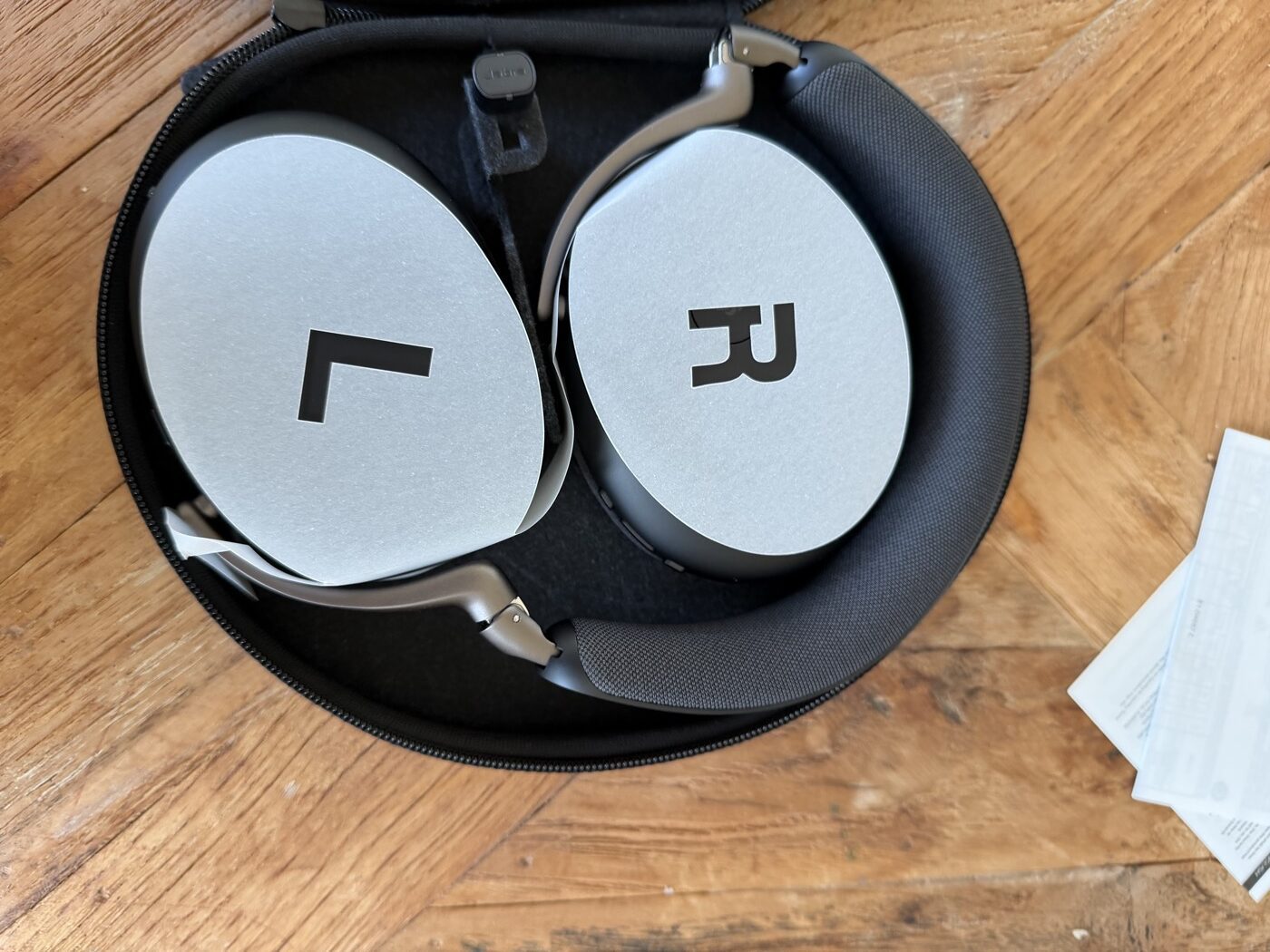
The mic arm is gone. The Jabra Evolve3 85 has no boom to flip up any more. Mute is a button on the right cup, and that took me a day to stop reaching for something that is not there. It does fix my second complaint, just not in the way I expected. I can no longer leave the arm in the wrong position, because there is no arm to leave anywhere. Jabra calls it a virtual microphone arm: six microphones and an algorithm doing the job the boom used to do.
What you give up is the glance test. On the Evolve2 85 the arm told me, and anyone walking past my desk, whether I was live. Now that job falls entirely to the busylight.
Pairing with my iPhone. Not smooth at first. The initial pairing just would not take, and I went through the usual routine of forgetting the device, restarting Bluetooth and trying again before it worked. Since then it has been fine, so I am not going to turn it into a verdict.
But I am also not going to leave it out, because reviews tend to quietly drop this kind of thing. First-run friction is real friction. If you are one person it costs you ten minutes of irritation. If you are rolling out two hundred of these it is a line in your deployment guide and a handful of calls to your service desk in week one.
The microphone, from the listener’s side. This is the only thing that really counts and it is exactly what you cannot judge from your own ear. I did not set up a lab test, because that is not how I use it. I asked. In our daily standups I simply said I was testing a new headset and asked whether it sounded different from usual. Nobody brought it up on their own. Once I pointed it out, the answer was that the audio sounded cleaner.
Noise cancelling in real conditions. ANC comparisons are usually about aeroplane noise. My reality is a dog, a street and the occasional builder. Then I was on a plane last week and it worked remarkably well. Well enough that the purser ended up tapping me on the shoulder to ask whether I wanted a drink. She told me she had already asked three times.
Switching between devices. This is the one that surprised me. The Jabra Evolve3 85 handles it much more smoothly than the old one. Where I used to end up checking which device owned the audio, it now simply follows me. Jabra moved to Bluetooth 5.3 with dual connectivity and Fast Pair, and whatever they changed underneath, I notice it every day. It is the reason this has become my go-to headset when I travel.
Teams integration. The Teams button behaves as expected.
The question you are actually asking
If you are reading this you are probably one of two people.
You own an Evolve2 85 and you wonder whether to upgrade. My honest answer: yes, this one is worth it. I do not normally say that. You do not replace a headset that works because a newer number came out. You replace it when something goes wrong in your working day that the new model fixes. The weight is not a spec on a sheet, it is something you feel every afternoon, and that is a real reason to switch.
Rolling out the Jabra Evolve3 85 across a fleet
You manage a fleet of fifty or two hundred headsets. Then this is not a product question, it is a rollout question. And these are the things that matter, not the sound:
- Can you manage them with your existing tooling, or does a second management layer appear?
- Do firmware updates run through the same channel?
- What do you do with a mixed fleet? Two generations side by side is fine, until your helpdesk has to maintain two sets of instructions.
- Are the ear cushions and spare parts interchangeable with what you already have on the shelf?
That last point sounds small and is not. The difference between one type of spare part and two is a year of friction for the people who run it.
Jabra’s own answers to those questions, from their own spec sheet rather than from my desk: management runs through Jabra Plus, Jabra Direct and Jabra Xpress, with remote firmware updates. The ear cushions and the battery are replaceable, which is a real change from treating a headset as disposable and matters at two hundred units. The headset is UC certified and TCO 10 certified.
I am listing those as claims, not findings. I tested one Jabra Evolve3 85 for a few weeks. That is not a rollout, and you should not take my word for how it behaves across a fleet.
What I think
If you are in the market for a new headset, check the Jabra Evolve3 85. I would recommend it even if you already have an older Jabra. The main gain is that you can wear it all day without noticing it.
What I do know is that most hardware upgrades in this segment do not solve a problem you hit daily. Sound was already good. Weight turns out to be the exception: taking that off your head is something you feel every single afternoon. Beyond that the gains sit at the edges. In how fast it connects, how predictably it behaves, how much you have to think about it.
And that cable behaviour sits right in the middle of that. It is not a feature request. It is one less thing to think about, and Jabra still has not given me that.
A good headset is one you never think about. That is a hard quality to capture in a review, and exactly why most reviews are about the wrong thing.
If you are here because you run Microsoft 365 for other people, two other pieces that land on the same desk: the new Teams Communicator app and what it means for compliance, and the new Teams messaging limits.
Jabra provided the Jabra Evolve3 85 for this test. No agreements were made about the content of this article.